

 IBP Uniuso Editorial Team
Polypropylene (PP) is a semi-crystalline thermoplastic made by polymerising propylene, a compound derived mainly from petroleum and natural gas. It is one of the world’s most widely used plastics because it is lightweight, durable, versatile and inexpensive.
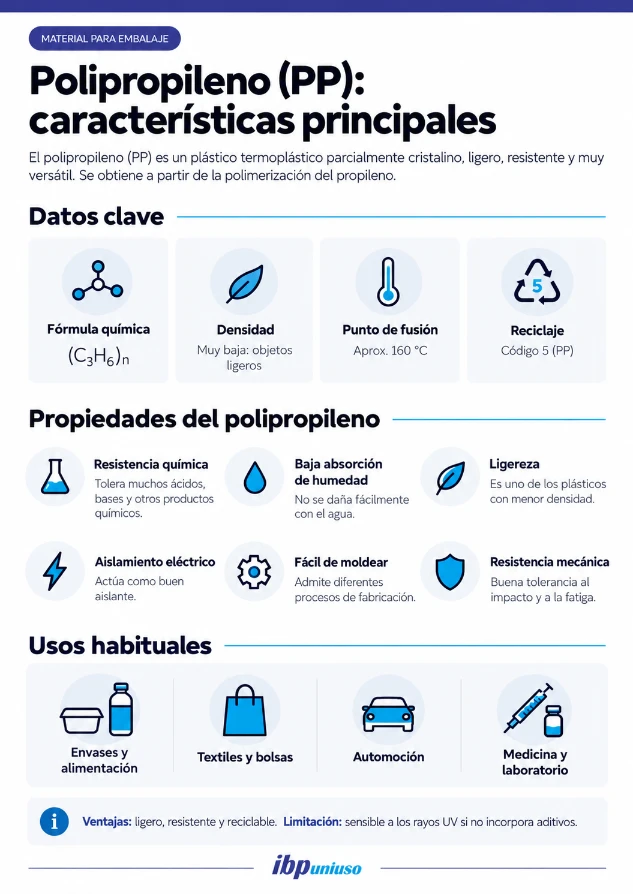
Its chemical formula is (C₃H₆)ₙ. It has a low density, resists moisture and can withstand relatively high temperatures. It is recyclable and carries resin identification code 5 (PP).
It is used in food packaging, bags, containers, textiles, medical supplies and automotive components, among other applications.
Characteristics and properties of polypropylene
The properties of polypropylene make it suitable for applications that require low weight, chemical resistance and ease of processing.
| Property | Polypropylene characteristics |
| Density | Approximately 0.90–0.91 g/cm³, making it very lightweight. |
| Melting point | Around 160–170 °C, depending on its composition. |
| Mechanical strength | Good resistance to fatigue and wear. |
| Chemical resistance | Resists many acids, bases and other chemicals. |
| Water resistance | Absorbs very little moisture. |
| Electrical insulation | A good electrical insulator. |
| Flexibility and rigidity | Vary with the formulation. |
| Processing | Suitable for injection moulding, extrusion, thermoforming and other techniques. |
PP is also easy to mould and colour, allowing manufacturers to produce different shapes and finishes. The maximum service temperature depends on the product and differs from its melting point.
What types of polypropylene are there?
The main types of polypropylene are homopolymer, impact copolymer and random copolymer. Each has different properties.
Polypropylene homopolymer (PPH)
Made by polymerising propylene, it offers rigidity, mechanical strength, thermal stability and a good strength-to-weight ratio.
It also offers chemical resistance and is easy to machine and weld. It is used in rigid packaging, industrial components and chemical industry applications.
Polypropylene impact copolymer (PPC)
It incorporates ethylene and offers greater impact resistance, even at relatively low temperatures.
Its combination of strength and flexibility makes it suitable for vehicle parts, containers and other products exposed to mechanical stress.
Polypropylene random copolymer (PPR)
It contains ethylene units distributed randomly along the polymer chains.
Its clarity, gloss, flexibility and impact resistance make it useful in packaging and containers that need a particular appearance.
Other forms of polypropylene: laminated, clear and biaxially oriented
Polypropylene is also available in several forms:
- Laminated polypropylene: durable, water-resistant films or coatings with matt, gloss, metallic or holographic finishes. They are used on brochures, magazines and books and are suitable for stamping.
- Clear polypropylene: used in packaging that lets people see the contents.
- Biaxially oriented polypropylene (BOPP): film stretched in two directions to improve certain mechanical properties. It is mainly used in flexible packaging.
These forms differ in how the material is processed or presented. They belong to the same chemical family.
What is polypropylene used for?
The uses of polypropylene span many sectors because it is strong, lightweight and versatile.
Polypropylene containers, packaging and bags
It is used to make bags, films, containers, caps and packaging designed to protect and display products.
BOPP polypropylene bags are clear, glossy and durable. They help protect items from dust and dirt.
Polypropylene in the food industry
PP is used in food containers, lids, trays and packaging because it absorbs little moisture and resists many chemicals.
Some containers can be used in a microwave if they are designed and certified for it. Check each product for suitability for food contact and heating.
Polypropylene in textiles, protective clothing and medical supplies
Polypropylene fibres are used to make carpets, ropes, sacks, clothing and technical textiles.
As a nonwoven fabric, it is used in protective clothing and single-use products for healthcare, food and industrial settings.
IBP Uniuso offers professional disposable clothing made from polypropylene, including disposable industrial caps, healthcare gowns and hygiene overshoes.
It is also used in syringes, laboratory tubing and certain surgical supplies, depending on the requirements of each application.
Other industrial and everyday uses
Polypropylene is also found in:
- Automotive: bumpers, battery casings and interior components.
- Electronics: housings and insulating parts.
- Construction: pipes, sheets and components.
- Textiles and furniture: carpets, chairs and garden furniture.
- Everyday items: toys, bags, utensils, corkscrews and sports equipment.
Advantages and disadvantages of polypropylene
The main advantages of polypropylene include:
- Low weight and good mechanical strength.
- Low cost and ease of manufacture.
- Resistance to moisture and many chemicals.
- Versatility in rigid, flexible and textile products.
- Potential for reuse and recycling.
Polypropylene also has some disadvantages:
- Prolonged exposure to sunlight can cause degradation without UV stabilisers.
- Some formulations become brittle at very low temperatures.
- Its resistance to heat and chemicals has limits.
- Effective recycling depends on waste collection and processing.
Frequently asked questions about polypropylene
What is the difference between plastic and polypropylene?
Plastic is a broad category of materials made from different polymers, and polypropylene is one type of plastic. Other examples include polyethylene (PE), PET and PVC.
What is the difference between polyethylene and polypropylene?
Both are thermoplastics in the polyolefin family. Polypropylene tends to be stiffer and more heat-resistant, while some types of polyethylene are valued for their flexibility.
Read more about the differences between polyethylene and polypropylene in our Spanish-language blog.
What is laminated polypropylene?
It consists of a polypropylene film bonded to another layer or substrate. It is used in containers, packaging and printed products to improve strength, protection or finish.
Is cellophane the same as polypropylene?
Traditional cellophane is made from regenerated cellulose. Polypropylene is synthetic. Some bags sold as cellophane are made from BOPP.
Is PVC the same as polypropylene?
PVC (polyvinyl chloride) and PP differ in composition and properties. PVC is used in pipes and cladding, while PP is widely used in packaging, textiles and industrial components.
Is polypropylene toxic or harmful to health?
Polypropylene is widely used in food and healthcare products. Manufacturing it does not require bisphenol A (BPA), and safety depends on the formulation, additives and conditions of use. Check that each product meets the relevant requirements.
Is polypropylene recyclable?
Yes, polypropylene is recyclable and carries resin identification code 5 (PP).
In Spain, household polypropylene packaging generally goes in the yellow recycling bin. Other items may require different collection schemes.
For more detail, see our Spanish-language guide to recycling polypropylene.


